|
Possible
Solutions for Homework 1 K
Foster, Economics of Environment, Eco B9526, CCNY Spring
2011 |
|
|
- Consider a market that can be represented by a
linear demand curve, QD = 25 – 3PD, (where QD
is the quantity demanded and PD is the price that demanders
pay) and a linear supply curve that QS = 2PS (where
QS is the quantity supplied and PS is the price that
suppliers get).
- Graph the two functions with P on the vertical axis.
Write these as
 and
and  so that they
are graphed as:
so that they
are graphed as:
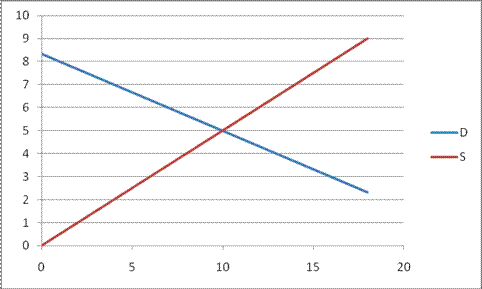
All these are in Excel sheet.
Find Qd = 25 – 3*7 = 4 and Qs = 2(7) = 14 so much more is supplied than demanded at this very high price. Only 4 is actually traded (the remainder piles up on shelves as unsold inventory) so PS and CS are as shown below:


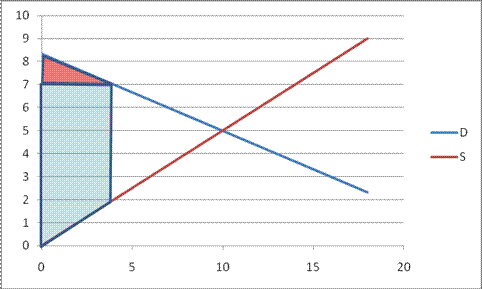
CS is the small pink triangle; PS is the large blue trapezoid. The area of CS has height (8.33 – 7) = 1.33 and base of 4 so area is 2.67. The area of PS is the sum of (7 – 2)*4 + (2*4/2) = 20 + 4 = 24. DWL is the large triangle with base of 6 and height 5 so 15.
- At a price of 2, how many units are demanded and
supplied? What would be Consumer
and Producer Surplus if this price prevailed?
At P=2, 19 are demanded but just 4 are supplied so just 4 are traded. This is


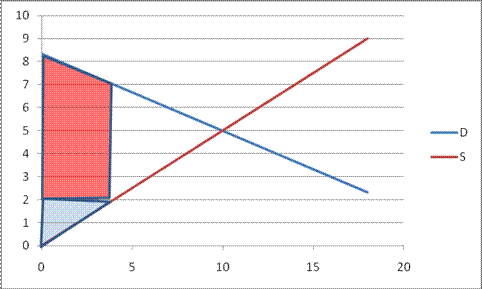
Now CS is the large pink trapezoid and PS is the small blue triangle. So PS is 4 and CS is 2.67 + 20 = 22.67. DWL is still 15
- Set PD=PS and QD=QS
and solve the system of equations to find the equilibrium (find the
intersection of the lines). Show
on the graph.
The intersection is where 25 – 3P = 2P so P*=5 and Q*=10.
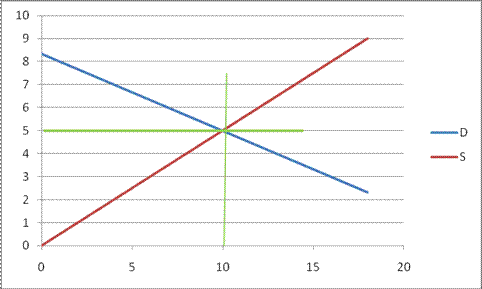
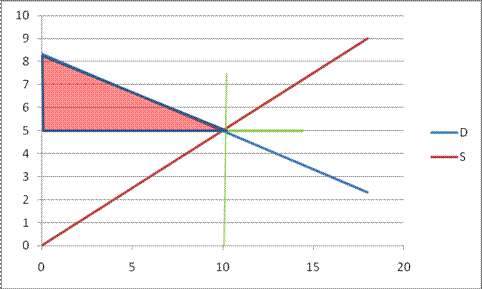
- What are CS & PS now? Show on the graph.
Now PS is the triangle with height 5 and base 10 so area 25; CS has height (8.33 – 5) and base 10 so area is (3.33*5)=16.67.
- Suppose the government sets a tax of $1 per unit. This means that PD = PS + 1. What is now the quantity demanded & supplied? What are CS & PS now? What is DWL?
Substitute into the price
equation, that PD = PS + 1 so 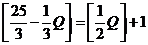 and solve to
get
and solve to
get  so
so  with Pd =5.4
and Ps = 4.4.
with Pd =5.4
and Ps = 4.4.
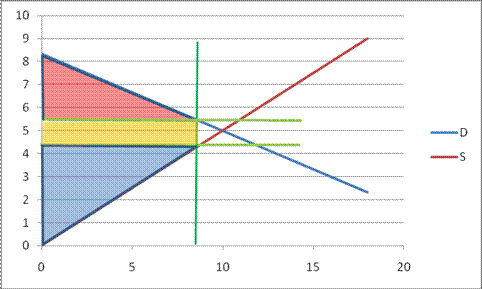
CS is the pink triangle with base 8.8 and height (8.33 – 5.4) so area is $12.9; PS is blue triangle with height 4.4 and base 8.8 so area is $19.6. Tax revenue is the yellow area: $1 per unit for 8.8 units so $8.8. DWL has base (10 – 8.8) = 1.2 and height 1 so area is 0.6.
Comparing these areas shows that we're always cutting up the same triangle (bounded by P-axis, supply and demand) into different segments:
|
Surplus
when P=7 |
Surplus
when P=2 |
Surplus
when P=5 |
Surplus
with tax |
|
|
CS |
2.67 |
22.67 |
16.67 |
12.9 |
|
PS |
24 |
4 |
25 |
19.36 |
|
Tax
revenue |
. |
. |
. |
8.8 |
|
DWL |
15 |
15 |
0 |
0.6 |
|
sum: |
41.67 |
41.67 |
41.67 |
41.66 |
- A small island can use its coast for tourism
(people are attracted to pristine coastline) or business/industry (which
destroys the tourist appeal). It
wants to choose what percent of coast should be preserved for tourism and
how much should be kept for industry.
Assume that the two industries can be modeled as follows. The coast (C) can be used for tourism,
T, or business, B, where each is a percentage so
 . The
number of businesses (in hundreds)
can be modeled as
. The
number of businesses (in hundreds)
can be modeled as  and,
symmetrically, the number of tourists (in thousands) is
and,
symmetrically, the number of tourists (in thousands) is  . Both
values evidently range from 0 to 10.
From combining the first two equations we can write
. Both
values evidently range from 0 to 10.
From combining the first two equations we can write  ; from the third equation we can write
  .
. - Write the equation giving B as a function of
T. Graph it. (You can use Excel to plot points if
it's easier.)
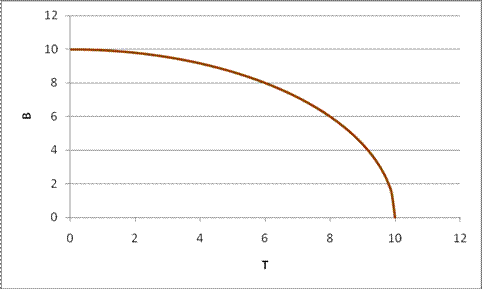
Substitute to find  . This is a
part of a circle,
. This is a
part of a circle,
- What is the opportunity cost, of business given
up, if the island moves from zero to one tourist unit? (You can use
calculus or find the change between values.)
This is moving from the point
(0,10) to (1, ), a change of 0.05.
(Shown on Excel sheet.) Or use
calculus to find
), a change of 0.05.
(Shown on Excel sheet.) Or use
calculus to find 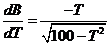 . The Excel
sheet shows that at T=1 this is -0.1.
. The Excel
sheet shows that at T=1 this is -0.1.
- What is the opportunity cost, of business given
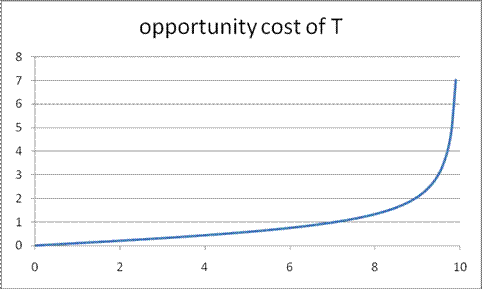
up, for each unit of tourism, if the island moves to 100% tourism? Plot the opportunity cost.
This is on the sheet or graphically
- Do the same exercise (find opportunity cost and
plot), but find opportunity cost in terms of tourists, for integer units
of business development.
Since B and T enter symmetrically, we could just swap axes and the answer would be as above.
- What is the best combination?
There is no way of saying. The "best" combination could be the
one which maximizes the function  but we have no
restrictions on the character of this U( ) function so there is no way of
giving an answer. If it were U=B or U=T
or U=B+T then there would be completely different answers. If both B and T have positive value then the
island should be on the PPF not the interior.
but we have no
restrictions on the character of this U( ) function so there is no way of
giving an answer. If it were U=B or U=T
or U=B+T then there would be completely different answers. If both B and T have positive value then the
island should be on the PPF not the interior.
- Please complete the "Problems for
Review" in the textbook: Chapter 2, Questions 3 and 4.
Question 3 likely gives a standard PPF, like that for B and T above, if we assume that it becomes steadily more difficult to get additional lumber output, as more land is cultivated for timber (and vice versa that cattle get more difficult, as more land is used for grazing).
Question 4 would have you draw 2 demand curves: the first has a vertical jump and the second is horizontal.