|
Possible Solutions to Homework 2 K Foster, Economics of Environment, Eco B9526, CCNY Spring 2011 |
|
|
- Consider a market that can be represented by a linear demand curve, QD = 40 – 2PD, (where QD is the quantity demanded and PD is the price that demanders pay) and a linear supply curve that QS = 0.5PS (where QS is the quantity supplied and PS is the price that suppliers get).
- Graph the two functions with P on the vertical axis.
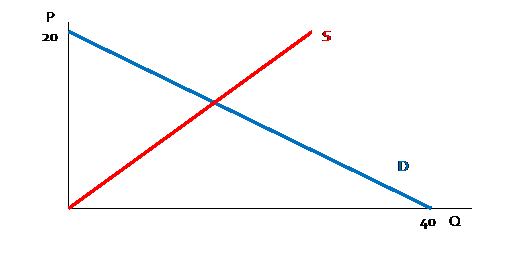
The lines are P = 20 – ½Q and P = 2Q; plot these as below:
- What is the equilibrium value in perfect competition if the good has no externalities in consumption nor production.
Find the intersection where P = 20 – ½Q = 2Q so 20 = 2.5Q and Q*= 8, P*=16.
- Suppose production of the good involved marginal external costs that raise costs by 2. What is the deadweight loss of the private market? What are PS and CS?
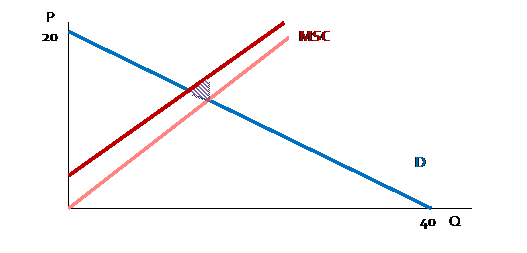
Now find the intersection of MSC (S + Marginal External Cost) = 2Q + 2 = 20 – ½Q, so Q** = 7.2 at a demand price of 16.4 and supply price of 14.4 (difference is 2). The DWL is the small triangle shown with height of 2 and base of 0.4 so area is 0.4. PS and CS are as before in competition but now total surplus must subtract the DWL. CS is the triangle with height (20 – 16) and base 8 so area 16; PS is the triangle with height 16 and base 8 so area 64.
- What tax rate could eliminate the deadweight loss? What would be PS and CS?
A tax of 2 would eliminate DWL although PS and CS would both be smaller; CS would be the triangle with height 3.6 and base 7.2 so area of 12.96. PS has height 14.4 and base 7.2 so 51.84.
- Suppose the government imposed a tax of $3 per unit. What is now the DWL? PS and CS?
At a tax of 3, Pd – 3 = Ps so substitute in and find 20 – ½Q – 3 = 2Q; Qt = 6.8, Pd = 16.6, Ps = 13.6. Now there is a small DWL, shown below.
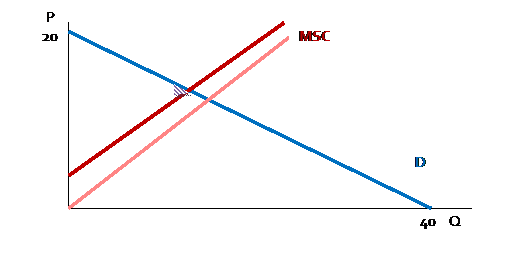
The height of the DWL is 1; the base is 0.4 so the area of DWL is just 0.2.
- Consider the market for a product with an output that pollutes the air. The industry's Supply curve (only including private internal costs) can be represented as QS = 4PS. The demand can be approximated as QD = 10 – 2PD. The industry's marginal external costs from pollution occur as MEC = 0.1Q – 2 whenever Q, the quantity produced, is greater than 2.
- What is the privately chosen equilibrium quantity and price, when neither demanders nor suppliers take account of external costs?
Rewrite demand as P = 5 - .5Q and supply as P= .25Q. Set them equal so 5 - .5Q = .25Q and solve to get Qp = 6.67 and Pp = 1.67.
- What is the MSC, the marginal social cost (the vertical sum of MC and MEC)?
MSC is the private marginal cost, P = .25Q, plus the marginal external cost, 0.1Q -.2 (whenever this external cost is nonzero; sorry for the typo) so MSC = .35Q - .2. (h/t Jan!)
- What is the social optimum level of production of this good? What is the deadweight loss created by a lack of government action?
Social optimum is where MSC = demand so .35Q - .2 = 5 - .5Q so Q* = 6.12. This implies a DWL from a lack of government action as being the triangle with base (6.67 – 6.12) = .55 and height of 2.13 – 1.67 = .47 so area of 0.128.
- Suppose the government introduced a tax (per unit of output) to try to move closer to optimum. (Recall that this means that PD = PS + Tax.) What tax would reduce DWL the most?
The best tax level would equal the marginal external cost when output is at the social optimum; the flat level per output would be .1Q – .2 = .42.
- If the government instead restricted the level of output through regulation, what regulation would be set?
The government could set the level of output to be less than 6.12.
- If demand for this product suddenly rose so QD = 12 – 2PD, what would be the effects of the tax or regulation that was imposed above? Is there DWL now?
If demand rose then the tax would impose a small DWL. Now social optimum is where P = 6 - .5Q = .35Q - .2 so Q** = 7.29. The tax of .42 would mean 6 - .5Q - .42 = .35Q - .2 so Qt = 6.8 so now there is insufficient production!
- Write a short essay (about 200 words) on one of the topics discussed by Liam Heneghan that you found particularly interesting (which might reflect a bit of additional research on your part). Each person should write their own essay although you should have someone in your study group proofread.
Answers will vary.