|
Lecture
Notes 3 Economics of the Environment and
Natural Resources/Economics of Sustainability K Foster,
CCNY, Spring 2011 |
|
|
Short Review
of Production
Production Externalities
In the
simplest case, we can examine a firm making a single private (rival and
excludable) output and incidentally a single public (nonrival
and nonexcludable) output (for now, we assume that
this public good is disliked). An easy
example could be a power plant which makes electricity and pollution. (Actually a variety of sorts of pollution,
which affect different groups of people: carbon, mercury, NOX, and sulphur dioxide are the main ones.)
In this case
the production can be shown as being like a production possibility frontier but
with the pollution increasing along with the output, something like:
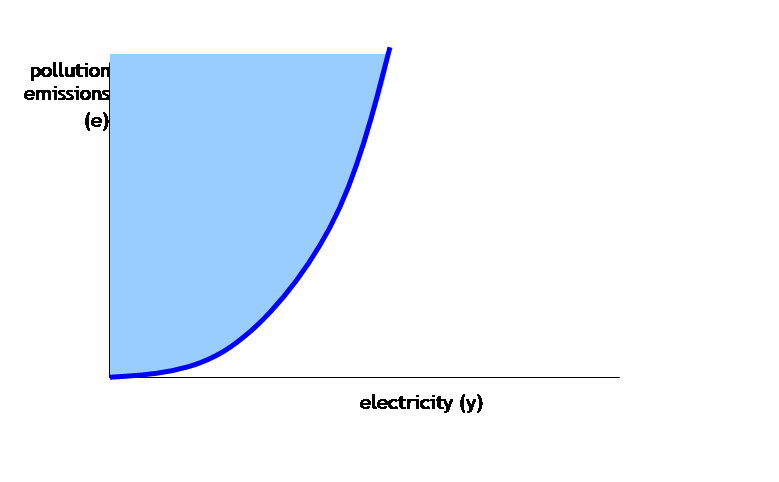
The firm can
choose any combination of electicity & pollution
within the light blue area. Clearly,
however, the firm would be foolish to choose a point inside the area; the
points at the dark blue line are efficient.
These are the production possibility frontier. They are efficient because there is no way to
increase the output of electricity without also increasing the output of
pollution (this would not be true for points in the interior).
|
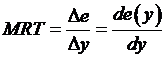
At any point along the frontier of production
possibilities, we can define the marginal rate of transformation as the
change in output of pollution per change in output of electricity – the slope
of the line. With the notation of e
for pollution emissions and y for the output of the firm, the marginal rate
of transformation, MRT, here is |
|





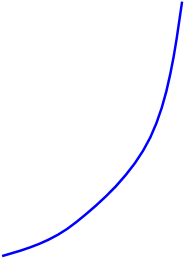

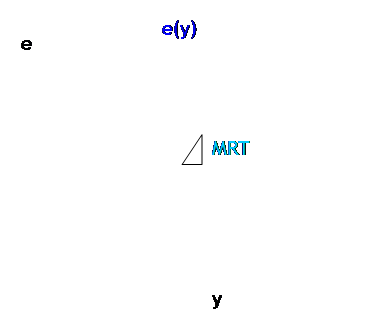
This
interpretation of the choice along the production possibility frontier as
representing a choice of marginal rate of transformation allows us to compare
firms and make statements about the relative efficiency.
Suppose
there are two firms which, for some reason or another, have different emissions
per unit of output. Graphically this
would be represented as:
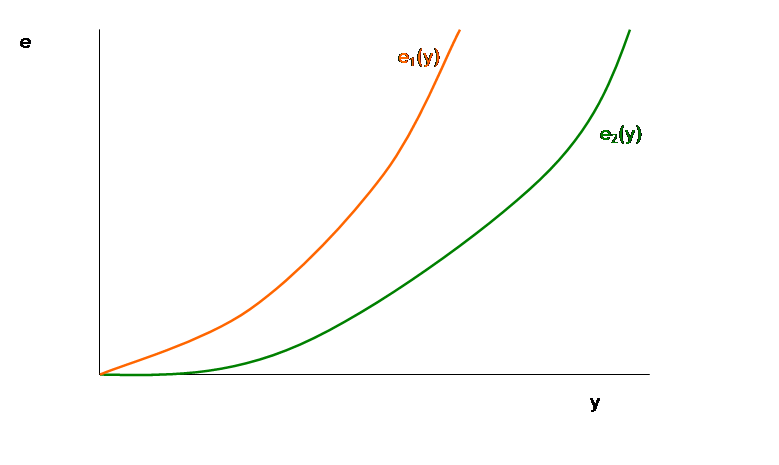
If they each
produced the same amount of emissions, they would of course be able to generate
different output levels, but their marginal rates of transformation would also
be different.
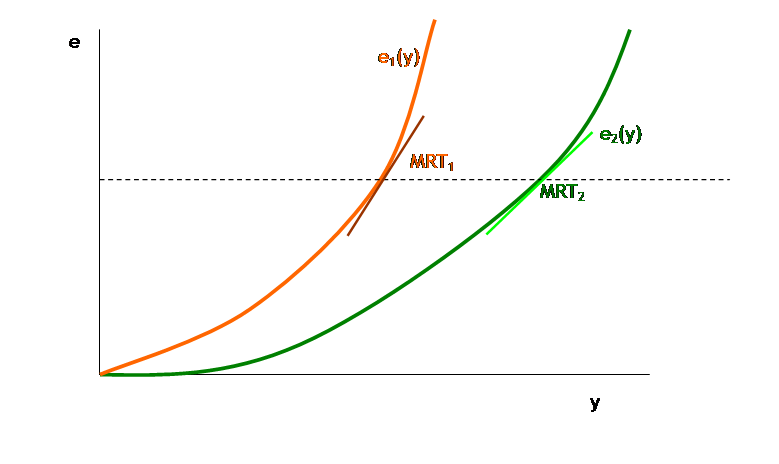
Clearly the
marginal rate of transformation of firm 2 is lower than the marginal rate of
transformation of firm 1. This means
that when firm 2 generates one more unit of output, it creates fewer emissions
than firm 1 does. This means that, if
firm 2 were to make one more unit of output while firm 1 made one unit less –
keeping the total output of the two firms at the same level, the increase in
emissions from the second firm would be (in absolute value) less than the
decrease in emissions from the first firm.
So total emissions would be smaller even though the output was kept
constant.
Consider a
simple numerical example, where  but
but 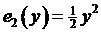 . This is plotted as:
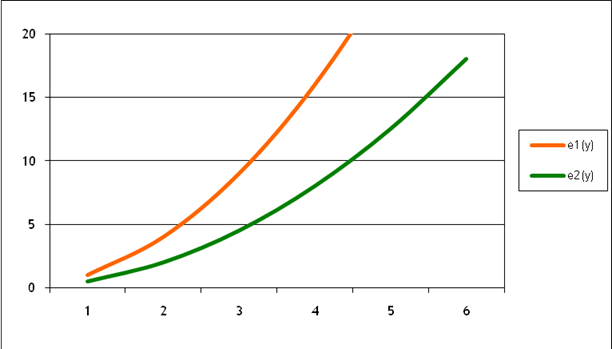
If emissions
of each firm are 16, then firm 1 is producing 4 units of electricity while firm
2 is producing 5.66 units of electricity.
If firm 2 produced one more unit of electricity its emissions would rise
to 22.16, an increase of 6.16. If firm 1
produced one less unit of electricity its emissions would fall to 9, a decrease
of 7. So if, instead of both firms
producing 16 units of emissions, firm 1 produced less and firm 2 produced more,
the overall production of electricity could remain constant while emissions
fall.
We can
continue this trade-off as long as the marginal rates of transformation are
unequal. It is only when the marginal
rates of transformation are equal that there will be a total efficient way of
getting the most output with the least amount of harmful emissions.
With a bit
more math, we can find the point where the MRTs for each firm will be equal.
|
Multiple Inputs |
|
|
It is rarely
quite appropriate to consider an output to be perfectly free, since there are
usually at least technological considerations.
So we can return to our usual marginal conditions, modified for the
firm. Consider a firm which has multiple
inputs available for making the output, each of which is useful and
productive. Each input has a cost (or
wage, if we extrapolate from the case of hiring workers) denoted wi.
We typically
assume that, holding all of the other inputs constant, increases to just one
input will have a steadily-decreasing effect on increasing output. Graphically, this says that for each input, xi,
i=1, 2, … N, output, y, increases as:
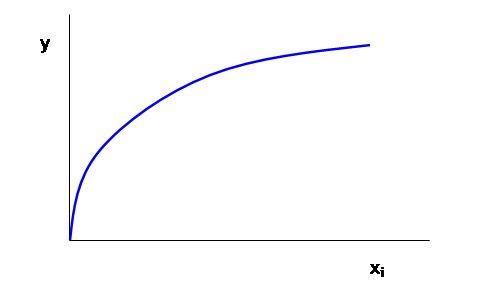
So, just as
with the consumer's diminishing marginal utility, the firm faces diminishing
marginal productivity. Just as with the
consumer, we define the production function as 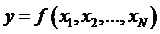 and the marginal product of each input as the
partial derivative,
and the marginal product of each input as the
partial derivative,  .
.
Also as
noted previously, the fact that each individual marginal product is diminishing
does not mean that production overall has diminishing returns to scale – where
'scale' refers to a case where all of the relevant inputs are increased. As a simple example, most offices generally
operate with each employee getting a computer.
Buying more computers without hiring more people might increase output,
but at a diminishing rate; the same would hold true for hiring more people
without getting more computers. But
getting more of both could allow the business to expand.
The firm
will maximize profits by choosing inputs such that (in the long run), the
ratios of  ,
marginal productivity per cost of each input, is equal. The explanation should, by now, be typical:
if spending $1 more on input i increased output by more than spending $1 more
on input j, then the firm should decrease spending on input i while increasing
spending on input j. This will not only
allow the firm to make more output more cheaply but also tend to bring down the
marginal productivity of input j while increasing the marginal productivity of
input i, so that in equilibrium we have
,
marginal productivity per cost of each input, is equal. The explanation should, by now, be typical:
if spending $1 more on input i increased output by more than spending $1 more
on input j, then the firm should decrease spending on input i while increasing
spending on input j. This will not only
allow the firm to make more output more cheaply but also tend to bring down the
marginal productivity of input j while increasing the marginal productivity of
input i, so that in equilibrium we have 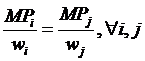 .
.
If one input
has a price which is increased (say, by some environmental regulation) then
this input will be used less. This is the substitution effect (see from
marginal condition).
There is
also a Scale Effect. As the cost of production
rises, the quantity of output demanded will fall, so fewer of all types of
input will be demanded.
Also, if
that input is non-excludable like polluted air or water, then other industries
could see their costs fall, so input used more – a different substitution
effect. Also a different scale effect.
Hicks-Marshall rules of Derived
Demand:
Demand
for input is more elastic when
1. technical substitution is easy
2. input cost share is high
3. input substitutes are supplied
elastically
4. demand for output is elastic
|
Social
Welfare |
|
|
It is
difficult enough to figure out how some impartial policy analyst might discover
these when social marginal cost or social marginal willingness to pay differs
from the private analogs, or what tax/subsidy would cure it. But that presumes that policymakers want to
maximize social surplus. To what extent
is that a good assumption?
First, how
exactly do we (ought we) define Sustainability?
Sustainability
and Sustainable Development
Principal
definition from the 1987 Brundtland Commission, Sustainable Development is
development that meets the needs of present generations without compromising
the ability of future generations to meet their own needs.
At the
American Museum of Natural History here in New York, the entrance rotunda has
the following words carved into the wall:
Nature
There is a delight in the hardy life of the
open.
There are no words that can tell the hidden
spirit of the wilderness, that can reveal its mystery, its melancholy and its
charm.
The nation behaves well if it treats the
natural resources as assets which it must turn over to the next generation
increased; and not impaired in value.
Conservation means development as much as it
does protection.
Theodore Roosevelt,
26th President of the United States (and the youngest ever) and also
a winner of Nobel Peace Prize, was a prominent advocate of conservation,
wilderness, and the AMNH. The last two
sentences can be seen as inconsistent and different varieties of
"sustainability" highlight one meaning or the other.
But Teddy Roosevelt's further quotes reveal
what he meant, "Conservation means development as much as it does
protection. I recognize the right and duty of this generation to develop and
use the natural resources of our land; but I do not recognize the right to
waste them, or to rob, by wasteful use, the generations that come after
us."
"Defenders
of the short-sighted men who in their greed and selfishness will, if permitted,
rob our country of half its charm by their reckless extermination of all useful
and beautiful wild things sometimes seek to champion them by saying the 'the
game belongs to the people.' So it does; and not merely to the people now
alive, but to the unborn people. The 'greatest good for the greatest number'
applies to the number within the womb of time, compared to which those now
alive form but an insignificant fraction. Our duty to the whole, including the
unborn generations, bids us restrain an unprincipled present-day minority from
wasting the heritage of these unborn generations. The movement for the
conservation of wild life and the larger movement for the conservation of all
our natural resources are essentially democratic in spirit, purpose, and
method." (Again, TR, A Book-Lover's
Holidays in the Open, 1916.)
Sustainability,
in whatever conception, is not straightforward to analyze within an economic
framework. We need to work out the
details of the definition farther.
|
From J.C.V. Pezzey & M.A. Toman,
(2008) "Sustainability and its Economic Interpretations," draft
chapter in Scarcity & Growth in the
New Millenium, ed R.U. Ayres, D. Simpson, & M.A. Toman. Big
question: can economy grow forever? Sustainability
in general is about equity between generations. Could either define it as equity of
outcomes (utility) or equity of opportunities. If look at outcome, then ask: can future
generations' utility continue without declining? If look at opportunity, then does wealth
never decline? Economic
problem: in many analyses we assume that people discount the future – find
the present discounted value of costs & benefits. We do this in analyzing investments by
private companies as well as governments.
But this discounting means that the welfare of future generations may
not be highly valued. Early
papers on economic growth provide boundaries of the problem. If there is a depletable natural resource,
then rational choice (discounting the future) by current generations implies
declining consumption over time. If,
on the other hand, technological growth is rapid enough, then the discounting
dilemma is solved: consumption can grow over time. The discounting dilemma shows that, even if
there are no externalities and every good is 'properly' priced, the economy
might still be unsustainable. First
question: so what? If every current
person likes the unsustainable path, then is there a moral basis to limit
current choice? If so, who will limit
current choices? Can we distinguish
between people acting as 'homo economicus' in markets but as 'Good Citizen'
in government? For a good review of
how important is economic growth to basic human welfare watch Hans Rosling's TED talk.
Do people
act rationally anyway? Do they discount
in that way? How do we deal with the
uncertainty inherent in some of these models?
No easy answers. Define
"Total Capital" as man-made capital (machines) plus human capital
(knowledge and expertise) plus natural capital (from the ecosystem). Write Often
distinguish between "strong" and "weak" sustainability -
weak sustainability implies that total capital does
not decline – but this can include cases where natural capital is used to
increase human or man-made capital.
This assumes that each type of capital is a perfect substitute for the
other. Also assumes that there is some
metric to convert all of the types of capital into a single unit (usually
present-value money) – otherwise how to add up machinery and university
degrees with coal fields, biodiversity, and clean water? -
strong sustainability implies that at least some component
of KN cannot fall below some critical value – there are threshold
effects. Precautionary Principle
follows. The Stern Report on Climate
Change ended up using this sort of argument to overcome the disagreements
about measurement that are inherent in the previous definition. -
Green Net National Product (GNNP) proposed to supplement GNP
to offset the depreciation of KNatural. Augmented National Income takes Green but
adds in technological progress.
Related is Genuine Savings,
which gives net investment after depreciation of all of the capital
amounts. So if Augmented National
Income is not rising then economy is unsustainable. -
if
economy has endogenous growth then this might be fast enough to overcome
environmental degradation -
Other
measures include "carbon footprint" (or other footprints) but these
lack clear justification |

Fundamental
question: if future generations will be much richer, then why must we now
sacrifice for them? Why should the poor
(us today) give to the rich (future generations)? Many countries and societies have developed
by first exploiting natural resources to get rich, then only later remediating
environmental harm (e.g. the
This
question of discounting arises often in policy disputes. We will come back to it (esp. in climate
change) but for now note that there is no simple answer.
Social Welfare
How can we,
as economists, say much about which outcomes are better than others, without
imposing our own particular ethics and morals?
Some outcomes might deliver high income inequality; some might constrain
inequality but with a lower average level of consumption. How can we say which is better?
I'll use the
general term "government" but this refers to any joint decision
making body. People get together to form
various organizations, which then promulgate rules that bind the members – any
of these organizations can be considered a 'government' from the view of social
welfare analysis. A building coop is a
'government' of a sort: it makes rules that (hopefully) help the people who
live there. Business Improvement
Districts join up local merchants. There
are unions and farmer marketing boards.
Then there are myriad levels of government in the conventional sense of
the word.
So how can a
government choose its goals? One of the
very minimal items that we might propose, is that we ought not to omit any
movements in allocations that are "Pareto improving." A Pareto improving trade gives something for
nothing – someone gets more utility without anyone else getting less
utility. Certainly these sorts of trades
ought to be made, right? So a
"Pareto optimal" economy has eliminated all of these possible trades
and has no more possibility of getting something for nothing.
This is what
kids do after getting Halloween candy: the one who likes chocolate best will
trade away the Starbursts and gummi bears to friends who like those more than
chocolate. Everyone wins.
The First
Welfare Theorem of Economics tells that every (frictionless) market equilibrium
is Pareto optimal. This tells us that,
based on the rather meager definition of "optimal" that we just gave,
that each market equilibrium meets this low criterion. This is nearly by definition: if there were
some trade that would make both parties happier, then they would make it in a
market economy (unless constrained by some friction; e.g. the whole Coase
discussion).
The Second
Welfare Theorem of Economics is more interesting. We just said that "Pareto optimal"
is a weak condition – a dictatorship where one person has nearly all of the
wealth, while the others toil in peonage, could be Pareto optimal. There are many possible Pareto optimal
equilibria. Suppose society had some
idea of which particular one it wanted – could a market economy get us
there? The Second Welfare Theorem tells
that every Pareto optimal allocation is a market equilibrium that started from
some initial endowment. So this makes a
lovely separation: if policymakers want to change which allocation they desire,
then they ought to change the initial endowments. The market system is not the reason for
inequalities or injustices – these mirror inequities in the original
allocations.
But, as we
said, there are many Pareto Optimal allocations – this is one consideration but
not the sole consideration. How can
society choose the "best" outcome?
The Second Welfare Theorem said that, if we had something to aim for, we
know how to hit it. But what do we aim
for?
Not every
Pareto Optimal allocation is very good: if we start from an aristocratic
society with 1% of people getting nearly all of the wealth while the other 99%
live at subsistence level, then there is no Pareto improvement that will help
the 99% who are peasants without taking something away from the aristocrats.
We would
like to have some sort of society utility function, analogous to an individual
utility function, so that we could use the rational choice apparatus to look at
social choices. Call this a "Social
Welfare Function," denoted W( ).
One idea for
a Social Welfare function is Utilitarianism, originally due to Jeremy Bentham,
which holds that we should just add up the utilities of the people in the
society, u1, … uN.
This sets
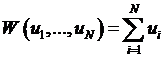 , or,
with slightly more generality,
, or,
with slightly more generality,
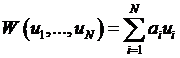 ,
,
where the ai
are weights. This has problems, chiefly
being the impossibility of measurement, then the impositions upon human rights.
Remember
from our definitions of utility functions that these are just arbitrary
functions which represent preferences; any monotonically increasing function of
a utility function is itself a utility function. One person's utility of chocolate could be
1,000,000,000; another's could be -1 but we CANNOT conclude that the first
person likes chocolate better. How can
we compare happiness levels?
Then there
is the problem of human rights: if we believe that people have "certain
inalienable rights" then the utilitarian framework could justify, say,
selling one person into slavery if the money raised can make others happy
enough.
The
philosopher John Rawls proposed a minimax function,
 .
.
He propelled
this function by arguing that most people's definitions of a fair allocation
depend upon their knowledge of their own situation: someone who is intelligent
might happily agree to a society where smart people are well rewarded; someone
else with different advantages would argue for a different allocation. He proposed a thought experiment: what
allocation would be chosen, if the members of society could get together before
they knew what their own situation would be – whether they would be fortunate
or unlucky, healthy or sick, endowed with which talents? They would have to make a decision from
behind a "veil of ignorance" over their future endowments. Rawls argued that, from this perspective, a
person would give a great weight to the worst possibility – extreme risk
aversion – that a society with substantial inequality would not be appealing
because even a small chance of being utterly destitute would be too large. Therefore he proposed a minimax principle,
that every change in allocation, away from perfect equality, must help the
worst-off person. So he would allow
greater rewards to, say, doctors, in order to give them incentive to help the
sick and the most fragile members of society.
These social
welfare functions so far allow people's utilities to depend on anything and
everything. We might further restrict
that people's utilities depend only on their own consumptions, in which case we
would have a Bergson-Samuelson welfare function. But this is not generally realistic.
Rights-based
social welfare functions run into difficulties since these generally do not
allow tradeoffs – a slight diminution in some right might make everyone better
off. But rights-based are generally
"lexicographic" preferences where no positive benefit can possibly
compensate ("lexicographic" since Azzz is alphabetized before
Baaa). Yet different people have
different ideas about which rights are most important (in the US, the Supreme
Court must adjudicate when there are competing rights clashing). Many people voluntarily surrender certain
rights in order to gain other benefits (e.g. a coop or condo association
restricts property rights but is beneficial to property values); it is unclear
why a social welfare function should not do so.
We might
hope for an answer like "democracy".
But Ken Arrow (CCNY alumnus and Nobel Prize winner) showed that a
democracy does not guarantee rational orderings of choices.
Arrow's
Theorem states that if we desire:
- Completeness: The social welfare
function, W( ), is defined for all allocations,
- The social welfare function is
responsive to individual preferences,
- It is independent of irrelevant
alternatives (so if W(X)>W(Y) then adding a choice Z, if W(X)>W(Z),
does not change the original ordering) (like Transitivity)
- It is not an imposed dictatorship.
Then, if
there are more than 3 choices, there is NO POSSIBLE Social Welfare function can
be guaranteed to satisfy all four conditions.
People care
about justice and fairness and other considerations. Too many policy debates result from arguing
about proposals, where each side uses radically different definitions of these
terms – what do justice and fairness mean?
Economists have proposed some definitions.
The Second
Welfare Theorem got us focused upon initial allocations, so we might wonder if
that will help. Is a symmetric
distribution, where everyone gets exactly the same bundle of goods, fair? If people's utility functions are not
perfectly uniform then people will voluntarily trade among themselves, and we
will move away from perfect equality. Is
this desirable? Would someone envy
another person's allocation? Define envy that person i would prefer j's bundle
rather than her own. An allocation is equitable if none of the bundles are
envied. Define a fair allocation as one that is equitable and Pareto efficient (i.e.
nothing is wasted). Now it can be proved
that if society starts from a symmetric distribution then the outcome of market
trading will be fair, under this definition.
(But the symmetric outcome is not generally fair.)
From the
definitions of Pareto optimality, economists have often backed off to the
measure, "Possibly Pareto Improving" (or Potentially Pareto
Improving), to indicate that some policy could generate enough surplus to
compensate the losers and still leave the winners with something. For example, a policy that gave A $100 while
costing B just $40 would be Possibly Pareto Improving since A could compensate
B the $40 lost and A would still be $60 ahead.
This is the theory behind the general introductory lesson on Deadweight
Loss (DWL) – that social surplus could be increased by enough to compensate the
losers and still leave the winners ahead.
This sneaks
back a bit of Utilitarianism into the argument – now we're comparing utilities
but using the measure of dollars (marginal willingness to pay).
The problem
with "Possibly Pareto Improving" policies is obvious: the
"Possible" does not mean that it actually does occur! A policy that made Bill Gates $100 wealthier
while making the poorest person $90 poorer would likely be condemned by a
variety of social welfare functions. But
it is "Possibly Pareto
Improving" (even if it is improbable that it actually will be). Policymakers could justify a progressive tax
on the theory that it distributes some of these Possible Pareto gains from the
winners to the losers, but the connection between this progressive tax and
other policies is often lost.
The typical
economist's tool of "Cost-Benefit Analysis" has this same
shortcoming. This would add up the
marginal costs of some policy, add up the marginal benefits, and then make the
change if the benefits outweighed the costs.
Again this avoids all questions of who gets the net (social)
profit! Cost-Benefit Analysis is the
same as Possible Pareto Improving.